Update: what changed since publication
Update 27 September 2026: Chania's price growth accelerated rather than settled. Asking prices there reached roughly 3,690 euros per square metre by August 2026, up from the 2,935 euros per square metre cited below for August 2025, a year-on-year rise of roughly 25 to 26 percent, notably faster than the 14.6 percent growth this guide originally reported. Heraklion remains the island's most affordable prefecture, still in the region of 2,000 euros per square metre, and Rethymno's growth has stayed more moderate, in the region of 5 to 7 percent a year. If financing is part of the plan, the 12-month Euribor, the reference rate for most floating-rate Greek mortgages, was trading around 3.2 to 3.3 percent in late September 2026 (3.331 percent on 23 September), up from roughly 2.7 percent in early July, following the ECB's second 2026 rate rise on 10 September. That doesn't change the 50 to 65 percent non-resident loan-to-value ceiling described elsewhere on this site, which is a bank credit-policy setting rather than a rate-linked figure, but it does mean any borrowing-capacity estimate should be checked against the current rate rather than a figure from earlier in the year.
Chania: the island's most international market
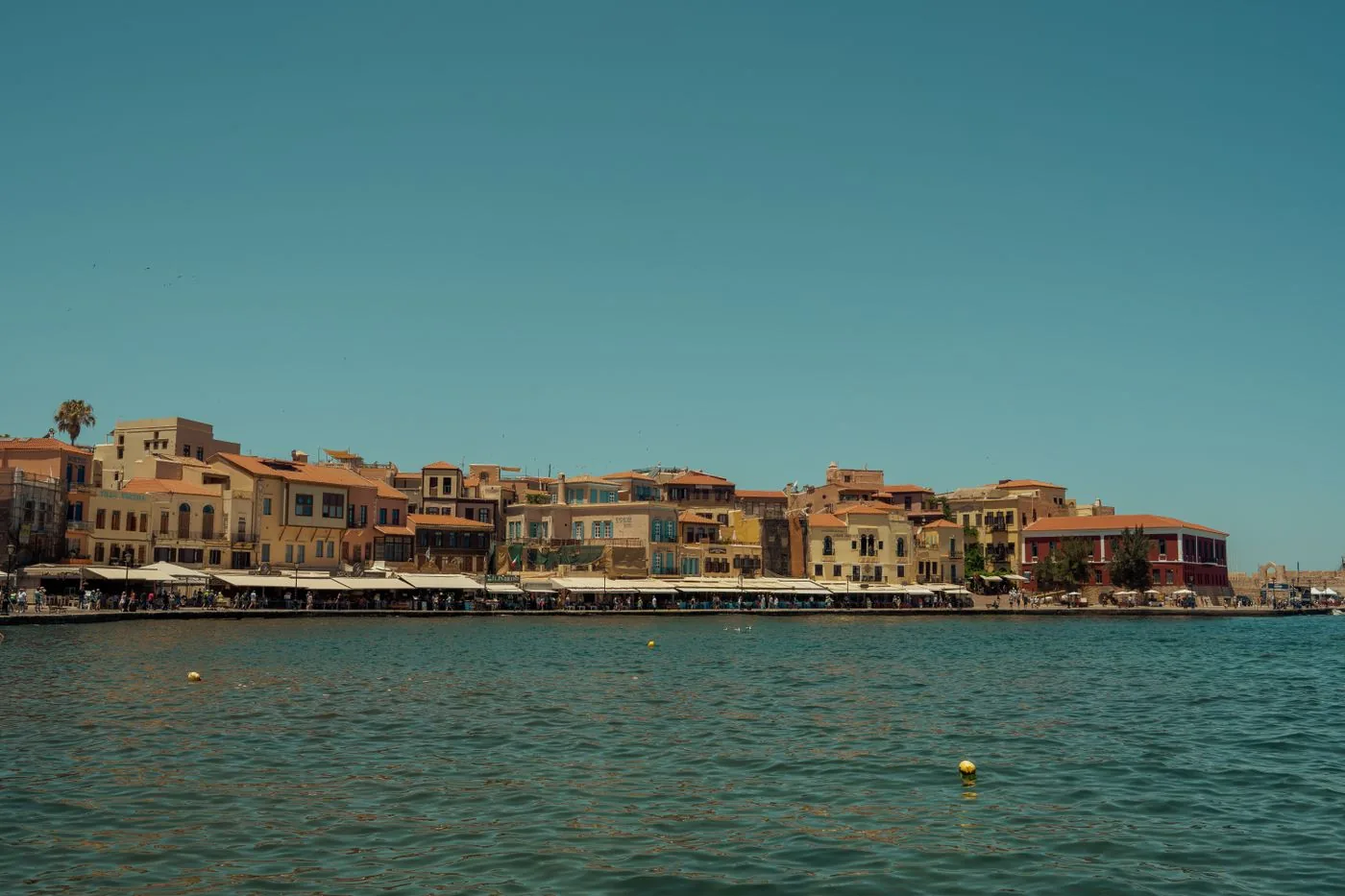
Chania, in the west, is consistently the most expensive of Crete's four prefectures. Asking prices there were reported at roughly 2,935 euros per square metre in August 2025, the highest on the island, driven by the Venetian old town, the coastal strip running west towards Platanias and a long-established international buyer presence. It is also the fastest-moving market on Crete, with year-on-year asking-price growth of around 14.6% in the most recent readings. If your shortlist is built from listings you found in English, there is a good chance it is concentrated here, and it is worth knowing that you are looking at the top of the island's price range rather than the middle of it.
Rethymno: the middle ground
Rethymno sits between Chania and Heraklion both geographically and in price, with a well-preserved old town, a long north-coast beach and a university population that keeps some of the town active outside the tourist season. Growth here has been more moderate than in Chania, at roughly 9.3% year-on-year. For buyers who want old-town character without Chania's premium, and who are willing to accept a slightly longer transfer from either airport, it is often the better value comparison to run.
Heraklion: the working capital
Heraklion is Crete's administrative and commercial centre, and its prefecture carried the island's lowest average asking prices in 2025, at roughly 1,999 euros per square metre, with the most modest growth of the four at around 6.4%. It is an urban, functional market rather than a scenic one, which suits some buyers and not others. What it does offer is depth: more transactions, more comparable sales and a property stock that is easier for a valuer to price than a one-off village house on a quiet stretch of coast.
Lasithi and the east: Elounda and Agios Nikolaos
Lasithi, at the eastern end of the island, contains Crete's best-known luxury pocket around Elounda and Agios Nikolaos, where villa pricing runs well above the prefecture's typical range. Outside that pocket, eastern Crete is quieter and less developed than the north-west, with a shorter season in many villages. Growth of around 7.4% year-on-year reflects that mix of a small high-end segment and a much calmer wider market.
Why Crete finances differently from a small island
The practical difference between Crete and a Cycladic island is not the lending criteria, which are the same, but the evidence available to support a valuation. Crete has a year-round resident population, continuous transaction volume outside the summer months and enough recent sales in most areas for a valuer to build a defensible comparison. On a small island with a handful of registered sales a year and a stock of unique properties, that exercise is slower and the result is less predictable. None of this makes a Greek mortgage automatic, and your income, deposit and documentation still decide the outcome, but it does tend to remove one source of delay.
The infrastructure question: Kastelli
Crete currently has two international airports, at Heraklion and Chania. A third, the new Kastelli airport roughly 35 kilometres east of Heraklion, has been under construction for several years, passed the two-thirds mark in late 2025 and is targeted to open in 2027. It is a genuine long-term factor for the centre and east of the island, and it is also the kind of project that appears in sales pitches as a guaranteed uplift. Treat it as context rather than as a number in your budget. A bank will value the property that exists today, not the connectivity it may gain in a few years.
Match the property to the finance
Decide whether the home is for vacations, relocation, retirement or rental before comparing mortgages. Intended use affects budget, insurance, tax questions and the contingency to retain, and a coastal villa bought mainly for personal use is underwritten differently from one intended to generate rental income in peak season. Crete's wide price range makes this more consequential than on a single-market island: the same total budget buys very different things in Elounda and in a Heraklion suburb, and the finance conversation follows the property, not the island.
Use local price evidence carefully
Island-wide averages, including the roughly 2,493 euros per square metre reported across Crete in late 2025, are useful for orientation and almost useless for a specific purchase. Each prefecture is its own market and coastal pockets diverge sharply from inland villages a few kilometres away. Asking prices for renovated listings marketed internationally may also not reflect completed sales of comparable registered properties. Keep enough deposit headroom in case the valuation comes in below the agreed price, and expect an unusual or unusually positioned property to take longer to value than a standard town apartment.
Practical checklist
- Shortlist a prefecture and property type before requesting finance.
- Compare price expectations across Chania, Rethymno, Heraklion and Lasithi, not just headline budget.
- Check which airport serves your shortlist, and how long the transfer really takes.
- Do not price future infrastructure, including Kastelli, into your offer.
- Do not rely on projected rental income for affordability.
- Allow for valuation differences between asking price and bank value.
- Arrange independent legal and technical checks.
Questions US buyers ask
Continue your Greek property research
Who made this guide. Bas Terpstra makes, reviews and approves every guide, using AI tools and public sources as a starting point. Rules and figures change, so treat this as general information and confirm the details for your own situation.
This guide is general information, not personal financial, legal, tax or currency advice. Mortgage availability is subject to credit, income, valuation and lender criteria.