Prices and financing update
Update 27 September 2026: The national price backdrop described below continues to hold. Bank of Greece's Q1 2026 reading of 5.6% year-on-year growth in urban dwelling prices was followed by a Q2 2026 index reading that kept rising, and Corfu's Kassiopi remains one of the fastest-rising micro-markets in the Greek islands, with reported gains still in the roughly 14-16% range over the past year and asking prices around €4,700 per square meter in mid-2026, among the highest in the Ionian. The two-speed pattern described below, softening low-end village and inland stock against a rising prime coastal segment, remains the accurate way to read this market. On financing, the 12-month Euribor, the reference rate for most Greek variable-rate mortgages, was trading around 3.2-3.3% in late September 2026 following the ECB's 10 September 2026 rate hike, a somewhat higher financing-cost backdrop than earlier in the year worth building into any affordability estimate.
A market moving in two directions at once
The single most useful thing to understand about the Ionian in 2026 is that it is not one market with one trend. Reporting on the islands through 2025 and into 2026 describes small inland and village houses, broadly the stock priced between roughly 50,000 and 200,000 euros, softening by as much as 15%, while coastal villas and the prime luxury segment continued to rise by up to around 10%. An island-wide average built from both of those movements describes neither of them. If you are shopping in one segment and reading price commentary drawn from the other, you will misjudge both your budget and how much room you have to negotiate.
Corfu: the anchor market, and the expensive one
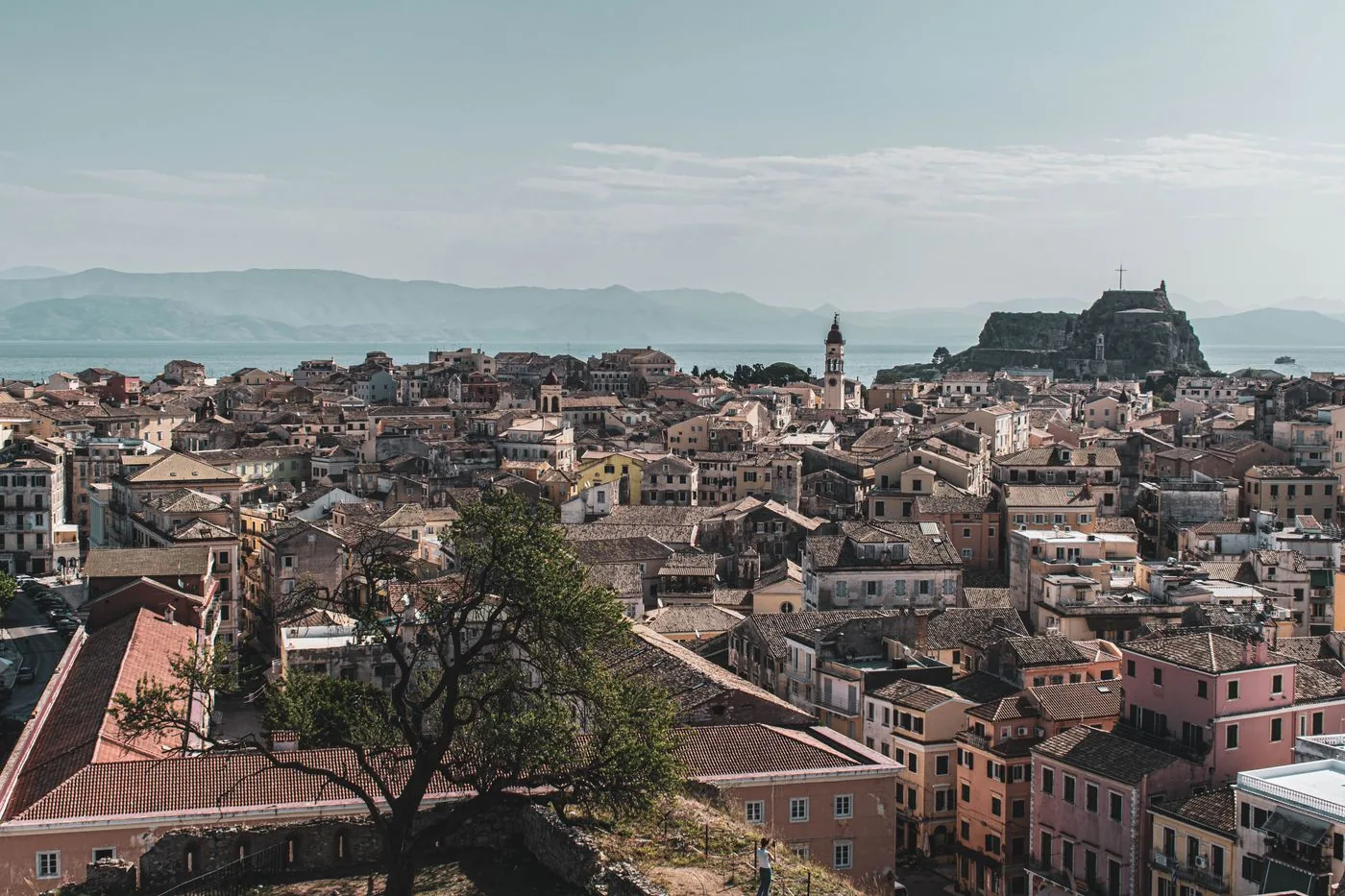
Corfu is the Ionian's international market, with a UNESCO-listed old town, a long-established northern European buyer presence and an international airport with direct seasonal connections. Reported price ranges on the island span very widely, from roughly 3,400 to 8,000 euros per square metre depending on where you are looking, with Corfu Town and the north-east coast typically producing asking prices somewhere between 300,000 and 900,000 euros for houses, heritage properties and villas. Kassiopi, on the north-east coast, has been among the fastest-rising pockets anywhere in the Greek islands, with reported gains in the mid-teens over the past year. What holds the top of this market up is scarcity rather than volume: the protected status of the old town and environmental restrictions along the coast keep genuinely buildable, sellable stock thin.
Lefkada: the island you can drive to
Lefkada is connected to the mainland by a causeway and floating bridge, which makes it the only Ionian island reachable by car without a ferry. That single fact changes a lot. It widens the buyer pool to include Greek mainland buyers making weekend trips, it supports more activity outside the summer season, and it makes the island materially easier for surveyors, valuers, lawyers and builders to reach. For a US buyer running a purchase remotely, the number of site visits somebody has to make on your behalf is not a trivial cost, and Lefkada is the cheapest island in the group to run that process on.
Kefalonia and Zakynthos: scale and season
Kefalonia is the largest island in the chain and has its own airport, a mountainous interior and a property stock that ranges from restored village houses to modern coastal builds. Zakynthos is smaller, flatter in its agricultural south and more tourism-driven, with a well-defined resort belt and quieter areas behind it. Both have enough transaction volume for a valuer to find comparable sales in the main areas, and both have pockets, particularly in the interior, where that becomes much harder. The practical question on either island is less which one you prefer and more whether the specific property sits inside or outside an area with a regular flow of registered sales.
Paxos and Ithaca: thin markets, patient timelines
Paxos has no airport and is reached by boat from Corfu or the mainland, and Ithaca is similarly small and quiet. Both are genuinely desirable and both are very thin markets, with few registered sales in a typical year and a housing stock made largely of one-off properties. Nothing about that prevents a purchase, and it does not change what a lender asks of you, but it does affect timing. A valuation that leans on two or three loosely comparable sales takes longer and returns a less predictable number than one drawn from a busy town market, and the gap between an asking price set for an international audience and a bank's assessed value tends to be widest exactly here.
What Greek price data does and does not tell you
Bank of Greece figures for the first quarter of 2026 put the annual increase in urban dwelling prices at around 5.6%, following average growth of roughly 7.8% across 2025 and 8.8% in 2024, with the "other areas" category outside the main cities rising by around 6.9%. That is a real and useful signal: the market is still rising, but the pace has moderated from the peak years. What it cannot do is price a specific villa on a specific stretch of Ionian coast. National and regional indices are built from a broad base of transactions, and the Ionian's split between a softening low end and a rising prime end is invisible inside them. Use the index to sanity-check the direction of travel and the local evidence to set your offer.
How the Ionian finances, in practice
The lending criteria do not change by island. Greek lenders assess non-resident applicants more conservatively than residents, on both the share of the price they will lend and the term they will offer, and the outcome turns on documented income, deposit and the property itself rather than on your US credit score. Two Greece-specific points matter more here than in a mainland city purchase. First, the assessed value a lender works from may be tied to the property's official taxation value rather than to what you agreed with the seller, and on the islands those two figures can diverge sharply. Second, older village and heritage properties frequently carry title, permit or extension issues that need resolving before a lender will proceed, and that work is slower on a small island than in Corfu Town. Neither is a reason to avoid the Ionian. Both are reasons to start the finance conversation before you commit to a deadline in a preliminary agreement.
Match the property to the finance
Decide first whether this is a vacation home, a future retirement base, a relocation or a rental asset, because that choice drives budget, insurance, tax questions and the contingency you should hold back. A restored stone house in a Kefalonian village and a north-east Corfu villa are not the same purchase in any respect that a lender cares about, even at the same headline price. And if part of the plan is to let the property when you are not using it, treat projected rental income as a bonus to your own budget rather than as something that will improve your borrowing capacity, and read up on the Greek registration and tax rules that apply to short-term letting before you build a spreadsheet around it.
Practical checklist
- Decide which segment you are buying in, because the Ionian's low and prime ends are moving in opposite directions.
- Check how your shortlist is reached: airport, ferry, or the Lefkada road bridge.
- Ask how many comparable registered sales exist near the property, not just what similar listings are asking.
- Expect thin-market islands such as Paxos and Ithaca to take longer to value.
- Have title, permits and any extensions checked early on older village or heritage stock.
- Keep deposit headroom in case the assessed value comes in below the agreed price.
- Do not rely on projected rental income for affordability.
- Arrange independent legal and technical checks before signing anything binding.
Questions US buyers ask
Continue your Greek property research
Who made this guide. Bas Terpstra makes, reviews and approves every guide, using AI tools and public sources as a starting point. Rules and figures change, so treat this as general information and confirm the details for your own situation.
This guide is general information, not personal financial, legal, tax or currency advice. Mortgage availability is subject to credit, income, valuation and lender criteria.